| WDR cameras can be used for solving the most difficult situations in
surveillance such as the foyer scenario. In recent years advances in picture sensors and picture processing have led to video cameras with significantly higher performance levels. High-performance wide dynamic range cameras which can be of versatile use in this area of application have been available for a number of years. The Wide Dynamic Range (WDR) property means that the brightest and darkest areas of an image can be displayed simultaneously. We know from other branches of technology (for example, audio systems) that the performance level of an information-processing system chain is determined by the performance of its weakest element. The performance of cameras has increased enormously -- so this article is dealing with the sharpness of the lens. | |||
By Dr. Kai
Pahlke
Is there anyone who hasn’t tried a strange pair of
glasses on, just out of curiosity or for fun?
Some people become glass wearers themselves. The world looks different to them and the
familiar becomes new and exciting.
Habits can change; they start reading again and move more confidently in
crowds. Surprised by this chain of
events, they ask themselves, how come they previously regarded their limited
perception as absolute. Someone who has
their eyes open has a new perspective.
I want to use this analogy to point to the key role of
optical systems in CCTV. In recent years
advances in picture sensors and picture processing have led to video cameras
with significantly higher performance levels.
High-performance wide dynamic range cameras which can be of versatile use
in this area of application have been available for a number of years. The Wide Dynamic Range (WDR) property means
that the brightest and darkest areas of an image can be displayed
simultaneously. We know from other
branches of technology (for example, audio systems) that the performance level
of an information-processing system chain is determined by the performance of
its weakest element. The performance of
cameras has increased enormously -- so this article is dealing with the
sharpness of the lens.
MONITORING
FOYERS
There are three characteristics of modern video cameras
which are especially closely linked to lens characteristics: Wide Dynamic Range
(WDR), natural color reproduction with increased color differentiation, and no
glare as well as the use of cameras with IR lighting. Cameras with these characteristics are
preferred for solving the most difficult situations in surveillance.
The foyer scenario demonstrates the necessity of the
WDR capability. The surveillance of
foyers -- usually rooms with large window areas in the background of the picture
-- means that continuous monitoring needs to be ensured during the day and, very
often, during the night as well. By day,
a variety of backlight situations can occur, whereas at night, inexpertly
installed light fixings can be a significant problem. The observer is primarily interested in
identifying the people in the room, whose faces are usually poorly lit. With the blazing light in the background, it
was impossible to produce usable image material over a longer period of time
using conventional technology.
Compromises often had to be made so as to get images on which people
could be identified at all. In this case
one would have tried to bypass the problem of the disruptive backlight by
repositioning and reorienting the camera.
Within modern glass buildings and at many exhibitions of high-value art
objects or jewellery such compromises can often not be made. A reliable remedy can only be provided by
cameras that are capable of compensating backlight situations in a reliable
automatic mode of operation. This
requirement by far exceeds a simple switching from normal operation to backlight
compensation because often the backlight situation will improve after a few
hours as the sunset and weather conditions change. Simply increasing the brightness of the image
by a few dB, an option that can be found in the menu of many cameras under ‘BLC
On’ will not suffice. Rather, an
application-oriented control of the dynamic range, the range of contrast as well
as the Gamma correction is required, which can only be realized with advanced
technology. With good reason, a renowned
chain store is using state-of-the-art WDR cameras to monitor its products on
strongly reflective shelves and above shiny marble floors. Investing in a discrete, vandal-resistant
model, available even with individual housing designs, pays off not just because
of the very detailed image material.
For technological reasons, certain cameras feature
another characteristic which often comes in very handy when monitoring foyers:
non-glaring. Extremely bright sources of
light create halos, whose size can only be minimized by using appropriate sensor
technology. If the morning sun was
located besides the person in the picture, the face of the person would
certainly be outshone. Even an LED lamp,
directed straight at the camera, would only slightly irritate the non-glaring
WDR camera because high-performance WDR cameras produce detailed reproductions
of the light source as well as the shadow.
Additionally, the foyer scenario poses high
requirements to the camera’s exposure control.
It is essential that individuals are rendered with adequate image
brightness. In order to ensure this,
Cam_inPIX technology offers a special preset which guarantees that, no matter
how dark it may appear in front of the window, the person is always rendered in
great detail.
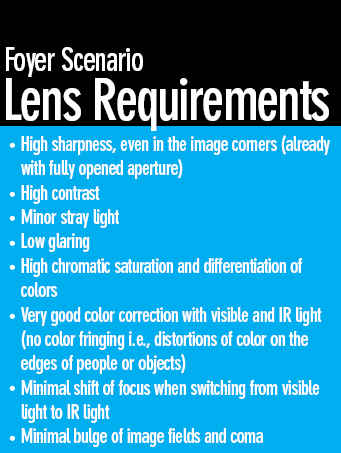
LENS
REQUIREMENTS
A camera that is particularly suited for monitoring
foyers features an individually selectable image detail, the so-called Backlight
Zone. This area can be changed in size
and appropriately positioned within the picture. The distribution of brightness in this image
detail is then used for the control of the exposure, the dynamic range, and the
Gamma correction. This functionality
offers further potential areas of application.
The number of day/night cameras on offer has risen
significantly over the past few years.
That is why, increasingly, day/night lenses are being used that are more
or less well corrected regarding the visible as well as the IR light.
Having touched on the various performance
characteristics of the cameras and a few examples of application, the following
list enumerates the corresponding lens requirements:
Usually, designs with aspherical lenses are used in
order to achieve high sharpness and contrast with a fully opened aperture. Apart from the lens design being an important
factor, minimal stray light, low glaring, high contrast and, partially, the
reproduction of colors significantly depend on the quality of the coating as
well.
Day/night lenses need to be corrected across a wider
spectral range, which is difficult to realize with small lens surfaces. Thus, the following problems occur:
Bulging of image fields and coma clearly show with some
objects at fully opened aperture and especially with images of punctate light
sources at night.
The pair of images of the foyer scenario demonstrates
that particularly the high contrast and a low sensitivity to stray light are
necessary to clearly show the dark person in front of the bright background.
Another phenomenon that can often be seen is that in
areas where ‘bright’ and ‘dark’ areas collide, a blue light appears which
spreads out across the area. This effect
shall be described as blue color fringing.
It occurs with lenses that do not have sufficient chromatic correction
with visible light.
The origin of this effect can easily be explained by
the fact that the white light comprises elements of every color. The types of glass used for lenses have
different refractive indices for different colors (dispersion), which needs to
be considered in selecting the suitable types of glass for the lens
systems. Lenses showing this color error
have a different focal point for blue than for the remainder of the visible
spectrum. This means that the blue image
of the line where the ‘dark’ and the ‘blue’ areas meet cannot be focussed
properly.
Due to the high levels of performance provided by
advanced camera technologies, those cameras are increasingly being used as
‘problem solvers’ in particular lighting situations. With the Cam_inPIX technology the strengths
and weaknesses of the lenses become more obvious as has been the case with
previous conventional technologies.
Correspondingly, the camera manufacturer recommends
suitable high-performance lenses.
|
.jpg)
.jpg)

- Get link
- X
- Other Apps

Comments
Post a Comment